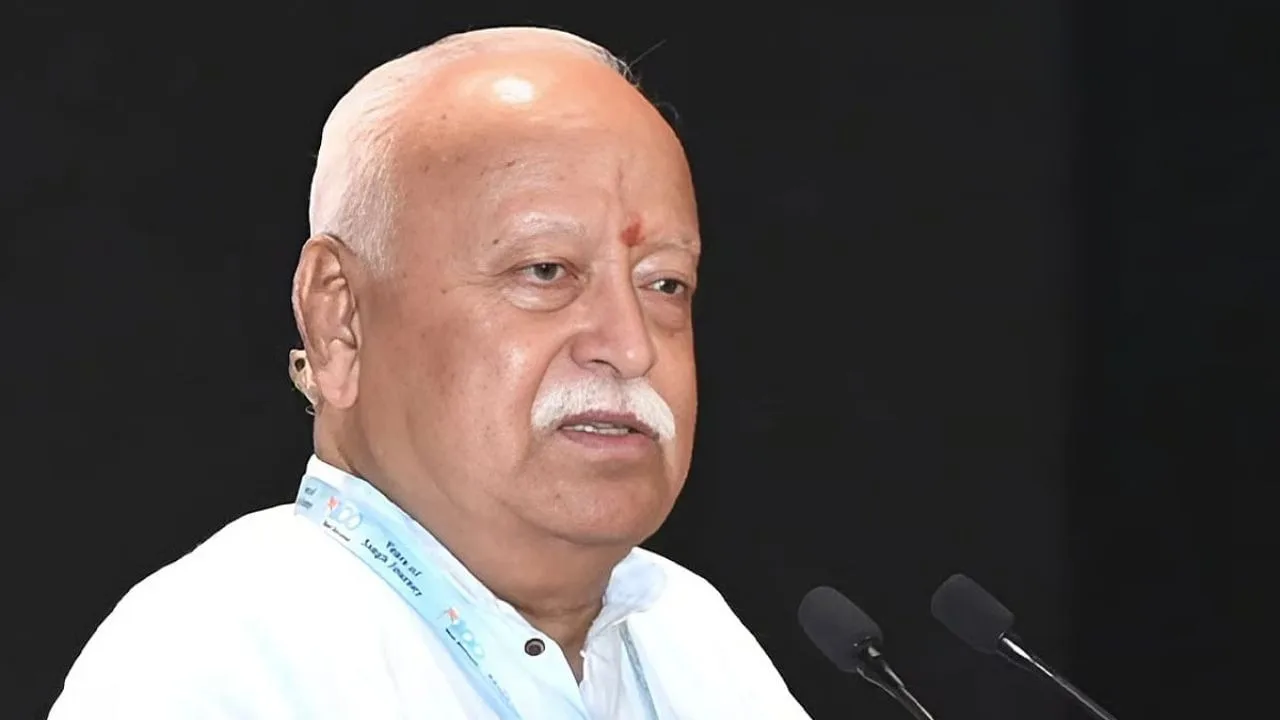
Bengaluru: Rashtriya Swayamsevak Sangh (RSS) chief Mohan Bhagwat has given a clear and assertive response to recurring political allegations regarding the Sangh’s legal status. Addressing queries about why the RSS is not registered under any law, Bhagwat said the organization has always functioned as an independent and constitutional body that pays taxes and operates transparently. Speaking at an interactive session organized as part of the RSS centenary celebrations at PES University auditorium in Hosakerehalli, Bhagwat said, “The RSS was started in 1925 when India was under the British rule. Should we have gone to the British to register our association? Even after independence, registration was never made mandatory. We are an independent organization — legal, constitutional and self-reliant. Hinduism itself is not registered, yet it thrives and guides millions”. His remarks came amid renewed political criticism of the RSS following the Karnataka government’s recent restrictions on its activities in public spaces. Several Congress leaders had questioned whether the Sangh operated under “a separate law”, alleging that it evades accountability by not being formally registered. Bhagwat’s response appeared aimed at putting such doubts to rest. “RSS is constitutional and pays taxes” Bhagwat strongly refuted claims that the RSS functions outside the legal framework. “We are a constitutional organization. There have been attempts to ban the RSS in the past, but every time, the courts have rejected such bans. We follow the law of the land and pay income tax regularly”, he stated. He emphasized that the Sangh operates with complete transparency, guided by discipline and patriotism, not by external compulsion or government regulation. “The RSS works for nation-building, not for political gains. Those who misunderstand our structure must first understand our values”, Bhagwat added. Inclusive philosophy: “All are children of Mother India” Responding to questions from participants on whether people of other religions are allowed to join the RSS, Bhagwat explained that the organization welcomes all Indians who see the nation as their motherland. “We do not look at people as Hindu, Muslim, Christian or of any caste or sect. Anyone who considers themselves a child of Mother India and follows our discipline can join the branch”, he said. However, Bhagwat clarified that those who join must do so by identifying with Bharatiya values rather than any specific religious identity. “In the Sangh, we do not promote one religion over another. We unite everyone under the larger cultural idea of Bharat. Religion, caste or language should not divide us”, he asserted. Also Read: ‘RSS at 100 – New Horizons’: Guests hail the role of Sangh in nation-building, cherish their enduring association A response to political rhetoric Bhagwat’s remarks come at a time when the Congress government in Karnataka has intensified scrutiny of organizations linked to the Sangh Parivar, even imposing restrictions on RSS shakhas in certain public institutions. Party leaders have often claimed that RSS operates without accountability. Bhagwat countered this narrative by emphasizing the moral and constitutional foundations of the Sangh’s work. He reminded critics that the RSS has existed for nearly a century, contributing to national reconstruction, social unity and cultural revival. “Our only aim is to strengthen society, not to create division,” he said. “Some people want to portray us as secretive or illegal because they fear the power of an organized and disciplined society”. Towards a century of service The event in Bengaluru drew thousands of invitees from Karnataka, Andhra Pradesh, Telangana, Tamil Nadu and Kerala, where Bhagwat engaged in an open dialogue on the Sangh’s role in modern India. As the RSS approaches its centenary in 2025, Bhagwat reiterated that the organization will continue to expand its activities based on selfless service, national pride and social harmony. “The Sangh is a movement of character, not of registration. Our strength lies in moral discipline and love for Bharat Mata”, he concluded.