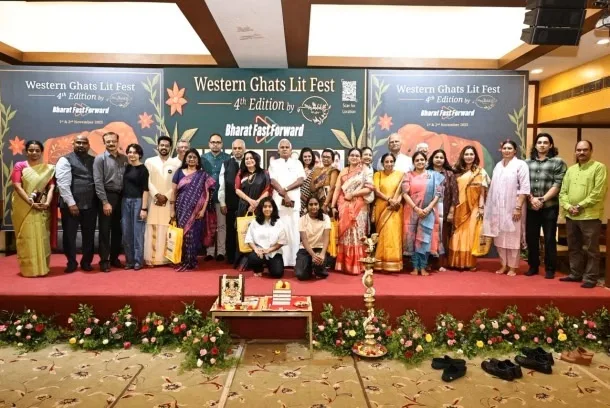
The two-day session of the 4th edition of the Western Ghats Literature Festival, conceived as a confluence of India’s intellectual, cultural, and literary currents, has evolved into one of India’s most thoughtfully curated platforms for the celebration of Bharatiya ideas, creativity, and consciousness, and was held on November 1 and 2. This year’s 4th edition theme was “Bharat Fast Forward”. This year too, as in earlier successful editions, the 4th-year event brought together 32 distinguished speakers from across Bharat, featuring prominent authors, thinkers, and cultural figures. The event included panel discussions, book launches, keynote addresses, and cultural performances covering a wide spectrum of topics. This year’s special edition included dedicated sessions on Defence, Indian Knowledge Systems, and Yoga. The two-day event began with the lighting of the ceremonial lamp, an invocation song by Sankar Narayanan, disciple of Carnatic singer KJ Yesudas, and Vedic chanting. The event made obituary references to Pahalgam victims and literary doyens who passed away. Shefali Vaidya, Director of Verandah Club, in her address said, “The Western Ghats Lit, a premier literary event in South India, is back with the third edition on November 1 and 2,” saying it is building on the success of its previous editions. She added that Western Ghats Lit Fest 2025 promises an immersive experience with a global perspective and a diverse range of speakers. Shefali Vaidya, who has been curating the events, said it was launched in 2022, amidst uncertainties after the COVID-19 pandemic. The first edition featured 16 speakers and laid the foundation for a vibrant literary platform to follow. Now they are in the 4th edition. She said, “We have an elite crowd, no shouting. This year there would be 15 book launches against 16 in last year’s 3rd edition. It is a meeting of minds,” she added. She described the Western Ghats Litfest as “rooted yet rational, emotional yet cultured, contemporary yet deeply civilisational”. Read More: Golkonda Literary Festival inspires to regain national glory in Telugu Land Dushyant Sridhar, spiritual discourse speaker and author, in his keynote address titled “The Eternal Echo of Epics”, compared this event to the place where three Vaishnavite Alwars met in a small space to escape from the rain and gave the Divya Prabandhams (a composition of 4,000 songs in Tamil praising Bhagwan Vishnu). He said the Lit Festival was the starting point of many ideas and a confluence of identical ones. “It is an event of knowledge.” He traced the Ramayan. Sage Agasthiyar’s student Tholkappian says his guru was the leader of the elite literature festival. The speaker quoted from the Ramayan’s Kishkinda Kanda and the dialogue between Rama, Lakshmana, Vanara king Sugriva, and Tara to underscore the necessity for ethical governance, promise-keeping, leadership restraint, and dharma sankalp in public life. Sridhar said the Ramayan exemplifies the four purusharthas—Dharma, Artha, Kama and Moksha. He explained that it applied Kautilya’s Saptanga model, Mandala theory, and Sadgunya diplomacy to highlight strategic clarity and ethical statecraft relevant to contemporary Bharat. The speaker cautioned against internal erosion, saying, “Societies collapse first in mind, then in matter. To protect Bharat, we must defend philosophy with practice, confidence, and continuity.” He also spoke on Sanatana Dharmas (which, he said, the present state government wanted to destroy). Sridhar said, “Atheists should not be ministers. But here, the entire cabinet is full of non-Hindu god believers.” Both the Ramayan and Mahabharat give us clues on these aspects. Next followed the panel discussion on “Swayam Bhodha, Shatru Bhodha” (knowing self and knowing others). Author Saiswaroopa Iyer moderated the panel with members Sumedha Verma Ojha, Pankaj Saxena, and Sampadananda Mishra. Pankaj Saxena said, “Without ruling ourselves, we can’t rule others. First conquer oneself before conquering others.” The panellists discussed the theme at length, quoting history and itihasas. The ‘Rishi’s Tradition of Bharat’ book was launched. In this session, advocate and writer MR Venkatesh and Sumedha Verma Ojha discussed Bharat’s ancient sense of statecraft. Venkatesh said, “We have a Christian Constitution in a Hindu nation because of past PM Nehru’s proximity with Britishers. He did not refer to or consider our trusted statecrafts like Chanakya’s Arthashastra or others to make our Constitution. There are stone inscriptions in Uthiramerur in Tamil Nadu which talked about civil democracy—the process to select village committee chiefs and members. Even PM Modi mentioned this in one of his addresses.” He said the Election Commission of India also noted this process, “but Nehru Westernised it as if we were not.” He said the British left India when the country had 505 princely states. Sardar Patel brought them into one national umbrella. “All Hindu kings readily accepted his idea, but two Muslim rulers did not—one was the Hyderabad Nizam and another was Jammu & Kashmir’s Sheikh Abdullah. We are duty-bound to rewrite our Constitution for the benefit of younger generations.” Venkatesh said there was “Romanisation” in 1491 by the Pope’s order. It talked about discovering new lands to convert them into Christian lands. “Discovery of India was one among them. Nehru copied this title for his book. Ambedkar was against Nehru’s way of writing the Constitution, but Nehru convinced others to toe his line. We are in a ‘Prestrevelika Tria Phobia’.” Historian Ojha recalled how tribals followed democracy in the sixth century. Their system had a chief executive or “head of state” (sometimes called a Raja or Pramukh) who was elected by the assembly for a limited term. Read More: Indian Knowledge System: From gurukul to global The next session was a speech by Priyam Gandhi Mody on “No Congress, No Nonsense: Chronicles from Political Bharat”. She said, “For reasons, Kashmir was kept burning. The Maharaja wanted Kashmir integrated into Bharat. He wanted to join. But Mountbatten spoke to him pressing him to join Pakistan, echoing Nehru’s stand. For the sake of Sheikh Abdullah, Nehru tried all tricks to prevent Kashmir from joining India. His stance was that Kashmiris were not Hindus but only Muslims. This continues even today.” On Operation Sindoor, she said, “We said it is not escalation, […]