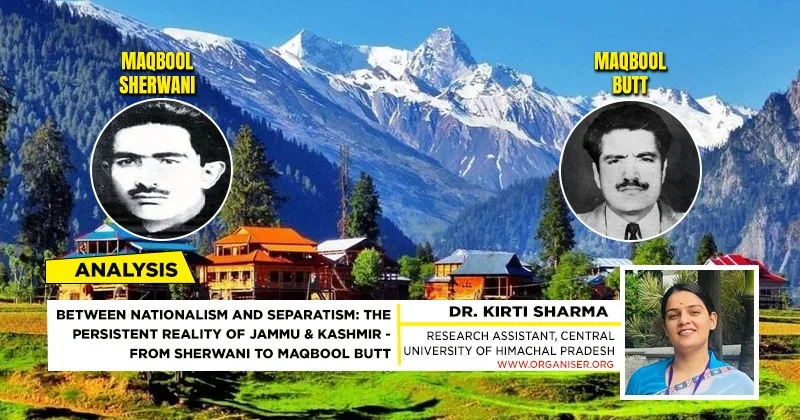
‘Kashmir’ is a word derived from the Sanskrit words ‘Kashyapa’ and ‘Mira’, signifying the sea, lake, or mountains associated with Sage Kashyapa. Many religions have flourished in Jammu and Kashmir (J&K), from Shaivism to Islam, and many rulers have ruled here, from the Mughals to the Dogras. The land has always provided its essence to every human that has lived on it, whether they ruled it or ruined it. Inhabitants of J&K have nurtured their native lands with their blood and sweat, sacrificing for the protection of the sacred land and its dwellers. At the same time, traitors have traded the land for their odious motives at the expense of innocent lives and the fortunes of its people. The indomitable spirits of its martyrs have fought against traitors for ages, despite their wicked motives for Kashmir. During 1947, when Pakistan attacked Jammu and Kashmir on October 22, the whole state was in confusion with deaths, rapes, loot, arson and other kinds of barbarity expected from Pakistani attackers. The entire state was divided into two groups: those who accepted the attack and believed it was the day of judgment, or wanted to have a new moon in Kashmir, but did not want to fight because they could not betray their Muslim brothers from Pakistan. Others believed that they cannot let anyone capture their land by force and torture because they have nourished it, and wanted to fight back attackers. Among the few who chose to resist Pakistani attackers during the 1947 attack was Mohammed Maqbool Ahmad Sherwani from Baramulla, a 19-year-old boy who displayed remarkable strength and courage in confronting the Pakistani attack on J&K. Sherwani kept state before religion, and the opposite was the case with traitors of Kashmir. Sherwani was recalled during such times as one who had attempted to disturb the public meeting that Mohammad Ali Jinnah addressed in 1944 on his way back from Kashmir. So, he was an eyesore to Pakistan. When Pakistan attacked Kashmir few Hindu families who escaped the wrath of Pakistani attackers from Muzaffarabad came to Sherwani and narrated the barbarity of the attackers on Hindus. Sherwani comforted families and helped them reach safer places. Sherwani gathered local people and trained them to counter Pakistani attackers. On his one call, villagers came forward to counter Pakistan. Meanwhile, when Sherwani was preparing for confrontation, Pakistani attackers captured Baramulla and killed eleven thousand Muslims there. When Maqbool left Baramulla for Srinagar, at that time, the attackers were a little far from it, and he was sure that the Indian army would arrive at Srinagar to help the people at Baramulla. But they were late because of the formalities of accession. So, he moved again to Baramulla to collect a force like in Srinagar with every old and young, and women in it to help the people to fight against attackers. Sherwani even diverted the attackers from reaching Srinagar. He cultivated friendships with the attackers and showed them the route opposite to one reaching Srinagar. His strategic move helped Maharaja Hari Singh to buy time to proceed with accession to the Union of India. Pakistani officers want Kashmir to join Pakistan to form a central Muslim state, which will connect their brothers in the Middle East and revive the glory of ancient Islamic democracy in a world ridden with disbelief. Somehow, Sherwani was captured by the eyes of the raiders, and they came to his home to arrest him. He escaped from the roof of his house but was captured by them because he fell into a drain. They smashed his head and beat him with the buts of rifles. They arrested him and took him to an old horse stable. The stable was congested with attackers and their bullets. When he was brought there, everyone gazed at him like he was a prisoner and everyone wanted to kill him like he was a traitor. Everyone called him a kafir. There was a leader of attackers called Zaman Khan, who locked Sherwani inside a dark room till Sardar Khurshid Anwar, the head of attackers from Pakistan, came to decide his fate. Maqbool Sherwani: The embodiment of nationalism In front of them, Sherwani was tortured brutally, but he didn’t say a word because he felt it was worthless to make them understand the importance of the Kashmiri land. Pakistani attackers wanted to know the purpose of Sherwani in the city and why he went to Srinagar some days back. Who were the people who were making plans to stop the Liberation Army of Pakistan from occupying Srinagar? Sherwani was accused of being pro-Bharat, who is helping India or guiding the Indian Forces. The attackers considered Sherwani to be a traitor because, being a Muslim, he was helping the Indian Army as well as planning with them to sell Kashmir into the hands of Jawaharlal Nehru through a “corrupt Hindu raja”. Because Sherwani misled the attackers to reach Srinagar, he became the biggest enemy of the brutal attackers. Maqbool Sherwani can protect his life from those attackers by accepting their offer to him of joining the Pakistan Liberation Army, but Sherwani refused the proposal again and again, because he cannot betray his land. For him, the dignity and honour of the land were important. Sherwani said, “The land which gave birth to me (Kashmir), this land which is like a poem to me, how shall I explain my love for it to you traitors (Pakistani attackers), from out of its valleys there has risen for centuries the anguish of torture…and we were trying to emerge from the oppression to liberate our mother, because we know her each aching caress…. And you have come and fouled her and wounded her! How could any of us stand by and not protest against your cruelty…” Sherwani want to die but does not want to recant and surrender his power of fighting for his land to such cowardly people. Kurshid didn’t declare the sentence of death to him, but Sherwani’s friend ordered […]