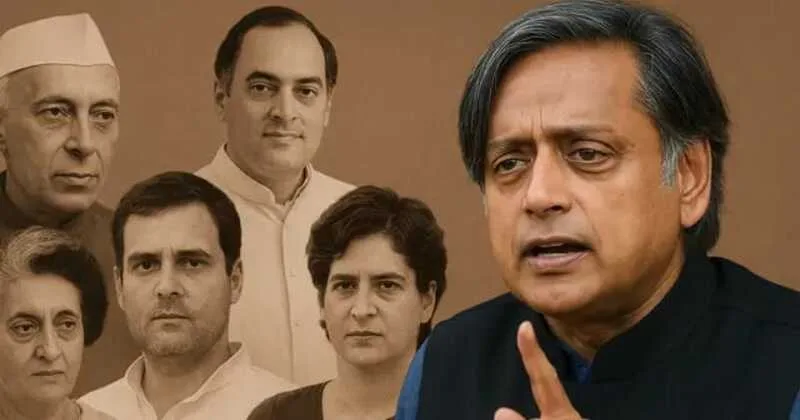
Congress Working Committee member and senior leader Shashi Tharoor’s latest article, sharply criticising dynastic dominance within the Congress, has sparked unrest inside the party. A section of leaders has urged the high command to consider disciplinary action against Tharoor for his remarks that it is time to prioritise talent over family inheritance and that influential political families maintain considerable financial capital, giving them an unfair advantage. Tharoor’s critique, they argue, echoes long-standing accusations made by the Bharatiya Janata Party (BJP) against the Congress. Despite the intensifying controversy, the Kerala state leadership has not yet issued a formal response to Tharoor, who currently serves not only on the Congress Working Committee but also on the Kerala Core Committee. His recent political engagements had signalled a possible closeness with senior party leadership; however, this fresh dispute has revived earlier tensions. The timing has worsened the situation, his article has appeared amid the local body elections in Kerala and is expected to influence the narrative in the upcoming Bihar elections as well. For the BJP, Tharoor’s dissenting stand has already become another tool to question the Congress’ internal functioning and credibility. Nehru Family at the Centre of Dynastic Debate The article titled “Dynastic rule: a threat to Indian democracy” was published in the Malayalam daily Mangalam. In it, Tharoor argues that the prominent role of the Nehru-Gandhi family, from Jawaharlal Nehru and Indira Gandhi to Rajiv Gandhi, Rahul Gandhi and Priyanka Gandhi Vadra, has laid the foundation for a widespread perception that political leadership in India is a birthright. While the most direct focus of his criticism is aimed at his own party, he also expands his argument to other regional and national parties where political families continue to dominate the decision-making apparatus. Among those mentioned are the Shiv Sena, Samajwadi Party, Lok, Shiromani Akali Dal, People’s Democratic Party (PDP) and Dravida Munnetra Kazhagam (DMK). Tharoor also highlights Telangana, where a clear succession battle is visible within the Bharat Rashtra Samithi (BRS), founded by K. Chandrasekhar Rao, whose son and daughter are reportedly vying for future leadership. Also Read: Karnataka Congress views on RSS: Irrational, Arrogant and Undemocratic According to Tharoor, Indian political parties must adopt a system of leader selection that is based on merit. Ensuring such change, he says, requires a collective effort to educate and empower voters to demand performance over pedigree. As long as politics functions like a family enterprise, he warns, the true spirit of democracy, “rule by the people, for the people, and by the people”, will remain compromised. He further contends that the disproportionate influence of the Nehru-Gandhi family has encouraged similar practices across political organisations nationwide. The entrenched tradition of prioritising lineage, he argues, weakens governance by sidelining merit and experience. Tharoor criticises dynastic politicians for inadequate engagement with constituents, noting that many feel little pressure to remain accountable that their electoral success often hinges more on a powerful surname than on their performance. He therefore advocates for internal party reforms, emphasising the importance of transparent internal elections and leadership selection based on competence. He also stresses the need for more fundamental structural reforms, from implementing term limits to mandating effective and democratic internal election procedures. The current lack of mobility and opaque decision-making processes within parties, he argues, allow a small elite to retain control with no incentive to transform the existing system. Internal rift widens ahead of elections These arguments have alarmed several party leaders, who have already conveyed their concerns to the central leadership. Yet, the Congress’ top brass continues to refrain from openly addressing Tharoor’s remarks, unsure of the political consequences, particularly given his roles in the Working Committee and the Kerala leadership during election season. Tharoor has, in recent years, made pointed interventions reflecting disagreement with the functioning of the Congress leadership. After a brief lull, he has once again raised a sensitive issue that directly challenges the authority of the Nehru family, a subject the BJP continually use to expose Congress as undemocratic. Tharoor’s comments also appear to underline his own political journey within the party. He had contested the AICC presidential election and has implied that the current national leadership actively opposed his bid. His renewed criticisms thus bring back questions surrounding his relationship with the party high command. For now, Congress leaders remain anxious about how best to respond, whether to defend the leadership against internal dissent or avoid escalation by downplaying the controversy.