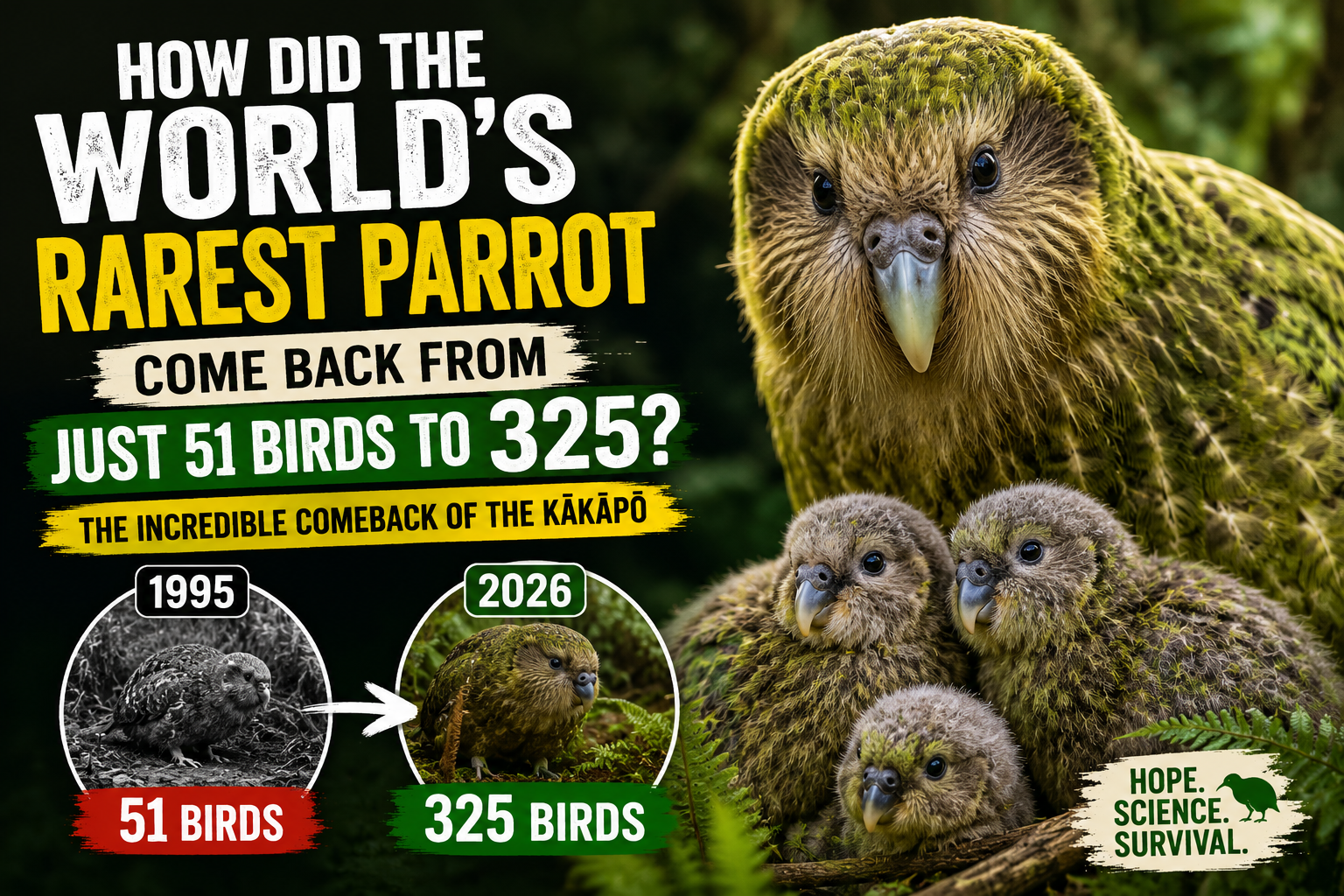
How Did the World’s Rarest Parrot Come Back From Just 51 Birds to 325?
For decades, the kākāpō looked like a species running out of time.
New Zealand’s strange, flightless and nocturnal parrot had been pushed dangerously close to extinction by introduced predators and habitat loss. When the country’s Kākāpō Recovery Programme began in 1995, only 51 birds remained.
Today, the story looks very different.
On September 1, 2026, conservation officials confirmed that the kākāpō population had reached 325 birds after 90 chicks from this year's breeding season became old enough to officially join the population count. It is the highest number recorded during the modern recovery programme and the first time the population has passed 300 in roughly 75 years.
A Parrot That Can't Fly
The kākāpō is unlike almost any other parrot.
It is flightless, nocturnal and unusually heavy, with adults capable of living for decades. Instead of escaping danger by flying into trees, the birds evolved to live mostly on the ground.
That became a serious problem after predators such as cats and stoats were introduced to New Zealand.
The surviving kākāpō were eventually moved to predator-free islands, where conservation teams could closely monitor them. Today, the recovery population lives on protected islands including Whenua Hou/Codfish Island, Pukenui/Anchor Island and Te Kāhaku/Chalky Island.
Why Did 90 Chicks Arrive at Once?
The answer is hiding in a tree.
Kākāpō breeding is closely linked to the rimu tree, whose fruit becomes abundant only during certain years. These mass-fruiting events can trigger breeding, meaning kākāpō may reproduce only once every two to four years.
The 2026 season followed a particularly strong rimu fruiting event.
That created an unusual opportunity: 79 females nested, 258 eggs were laid and 106 chicks hatched. Ultimately, 90 chicks survived to 150 days the age at which they are considered independent enough to be added to the official population.
From 51 Birds to 325
The numbers become even more remarkable when viewed over time.
In the early years of the recovery programme, producing 90 chicks could take 16 years. This year, the same number reached independence in a single breeding season.
But 325 doesn't mean the kākāpō is safe yet.
The species remains critically endangered, and conservationists still have to deal with limited genetic diversity, disease risks and the shortage of large, predator-free habitats.
The next challenge is therefore bigger than simply producing more chicks: creating places where kākāpō can eventually live and reproduce with much less human intervention.
For now, though, 325 birds represent something remarkable.
A species that once had only 51 individuals left has crossed a milestone that seemed almost impossible three decades ago.
The kākāpō isn't out of danger yet.
But for the first time in generations, its story is moving in the right direction.