Why Humans Throw Parties for the Things They Fear — The Hidden Logic of the World's Strangest Festivals
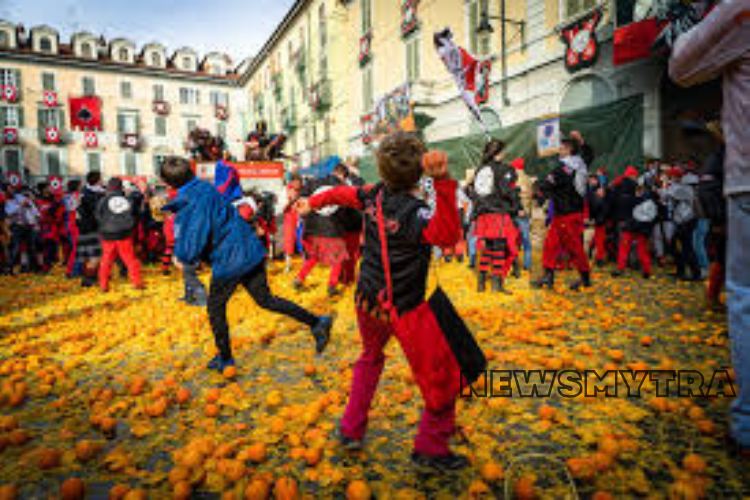
In Spain, men dressed as devils leap over rows of newborns. In India, women chase men with sticks. In Japan, wrestlers compete to make babies cry. They look like chaos. They're actually one of the oldest, wisest tools humanity ever built.
In a small Spanish village, once a year, a man dressed as the devil takes a running start and leaps — over a mattress laid in the street, on which lie rows of babies born in the past twelve months. The crowd doesn't gasp in horror. The parents are smiling. This is El Colacho, and it has happened, more or less like this, since the 1620s. A thousand kilometres of imagination away, in the Indian town of Barsana, women raise wooden sticks and drive the men of a neighbouring village out of the streets, laughing, while the men shield themselves and beg for mercy. And in Tokyo, giant sumo wrestlers hold up infants and do everything they can to make them wail, because the loudest crier wins.
Your first instinct is to call these bizarre. Hold that instinct. Because once you understand why they exist, something strange happens: they stop looking like the world's weirdest parties and start looking like the world's oldest therapy. And the deeper you look, the more you'll notice you've been doing the exact same thing your whole life.
Here is the idea this whole article turns on: the strangest festivals on Earth are not about celebrating something joyful. They are about taking something frightening — sin, disease, death, chaos, the terrifying fragility of a child — and rehearsing it, safely, as a community, until it loses its power over you. Call it Rehearsed Fear. Every one of these festivals runs the same three-step program: name the fear, act it out in a way that can't truly hurt anyone, and share it so no one carries it alone.
Spain: leaping over the fear of losing a child
For most of human history, a newborn's first year was a coin-flip with death — disease, misfortune, the invisible. El Colacho takes that unbearable parental terror and gives it a shape you can watch leap away. The men in devil-red are believed to gather up the babies' "original sin" and misfortune, and then jump clean over the infants, carrying the danger out of the village with them. Whatever you believe about sin or devils, look at the emotional machinery: a parish takes its most private nightmare — my baby could be harmed by something I can't see or fight — and turns it into a public act in which the danger is personified, and then physically removed. The fear is named. It is acted out. It is shared. That is not primitive. That is sophisticated.
Japan: crying the evil away
Naki Sumo, the crying-baby festival, runs on the same engine from the opposite direction. A frail infant, and the ancient dread of the spirits that might prey on it, meet an old Japanese belief that a baby's loud cry wards off evil — captured in the proverb "crying babies grow fastest." So the wrestlers don't hurt the babies; they provoke the very cry that a parent normally fears, and reframe it as strength, health, and protection. The thing you're afraid to hear at 3 a.m. becomes, for one afternoon, the sound of your child winning. Fear, flipped into a blessing.
India: dancing with the fear of desire and power
Barsana's Lathmar Holi looks, on the surface, like a fight — women beating men with lathis, sticks. It is in fact a joyful reenactment of a legend: the god Krishna coming to tease Radha and her friends, who chase him off. But notice what it lets a community rehearse: the charged, sometimes uneasy tensions between men and women, desire and consent, power and its reversal — all of it turned, for one controlled and consecrated day, into laughter, where the usual hierarchy is safely flipped and no one is truly harmed. It's a fear — of the frictions between us — dressed up as a game, so those frictions can be felt and released instead of buried.
The moment to stop and notice
Now here is the part that should make you pause, because it's about you. You think you don't do this. You do. Every October, millions of people pay money to walk through a haunted house so that a stranger can jump out and terrify them — rehearsing the fear of death, safely, for fun. A funeral wake is a festival for grief. A roller-coaster is a rehearsal for falling. A war film, a horror novel, a child shrieking with delight as a parent pretends to be a monster — all of it is Rehearsed Fear. The Spanish villager leaping over babies and the teenager screaming in a haunted maze are running the identical ancient program. We have never stopped throwing parties for the things we're afraid of. The costumes just change.
What this teaches us about being human
Step back far enough and something remarkable comes into focus. Cultures that never met — in Spain, in India, in Japan, and in hundreds of other places — independently invented the same tool. No one taught them to. When human beings are faced with a terror too big to defeat and too permanent to avoid — death, sickness, chaos, the vulnerability of the people we love — we do not simply suffer it. We ritualise it. We give it a face, a date, a costume, and a crowd, and we practise feeling it together until it becomes bearable. Festivals, in this light, are not decoration on top of culture. They are load-bearing. They are one of the oldest technologies our species ever built for the impossible task of staying sane in a dangerous world.
Which raises an uncomfortable question for our own time. As modern life quietly strips away its rituals — as we mark fewer thresholds, mourn more privately, and turn our fears into anxiety we scroll through alone at midnight instead of fear we act out together in daylight — we may be losing something we never understood we had. The devil leaping over the babies knew a secret we're forgetting: a fear you face alone can crush you, but a fear you can dance with, in a crowd, in costume, once a year, loses its teeth. The world's strangest festivals aren't a museum of human superstition. They're a manual — for the one problem no amount of progress has solved, which is how to be a fragile creature, who loves other fragile creatures, in a world that can take them away. We should think very hard before we stop dancing.
Sources
- El Colacho baby-jumping festival — National Geographic
- Baby jumping (El Colacho) — Wikipedia
- Naki Sumo Crying Baby Festival — Wikipedia
- Lathmar Holi: why women beat men with sticks — Outlook India
Keep exploring: the science of synesthesia · India's "mystical" places, explained.