India's "Mystical" Places, Explained — Where the Real Story Is Stranger Than the Myth
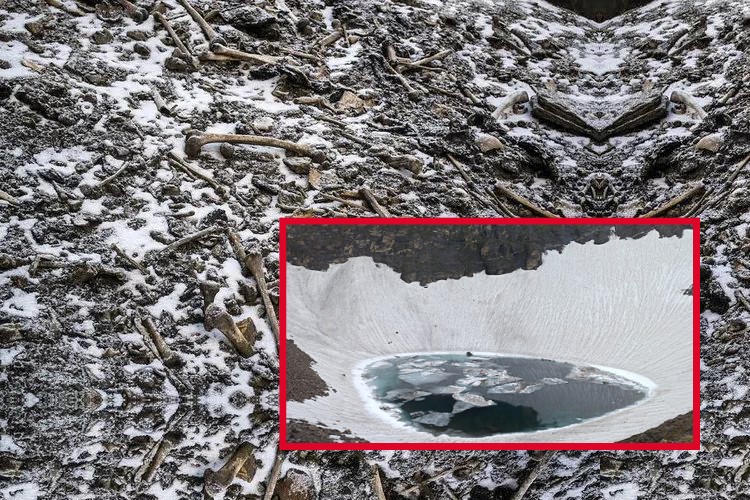
Every summer, as the ice on a lake high in the Himalayas begins to melt, something surfaces that has no business being there: human skeletons. Hundreds of them, scattered across the shallows at 5,000 metres, where almost no one lives and almost no one dies. For a thousand years, the people of the region had one explanation — a goddess, enraged, had struck down a party of trespassers with a storm of iron-hard hail. It was a myth. It was also, it turns out, not entirely wrong. And it's only one of the places where India has spent centuries calling something supernatural — right up until the moment science walked in and found the truth was even harder to believe.
Here is the thing most people get backwards about India's "mystical" places. They assume the choice is between magic and disappointment — that once you explain the mystery, the wonder drains out of it. India proves the opposite. The magic was never fake. It was physics we hadn't met yet — and often the physics is more astonishing than the story it replaced. Almost every "mystical" place hides one of four kinds of secret.
Four kinds of secret
| The secret | What the "magic" was hiding | A real Indian place |
|---|---|---|
| A trick of the senses | Your own perception, fooled | Magnetic Hill, Ladakh |
| A trick of biology & weather | Animal instinct + fog and wind | Jatinga, Assam |
| A scar from the sky | A meteorite impact | Lonar Lake, Maharashtra |
| A secret of history | Ancient DNA and migration | Roopkund, Uttarakhand |
A trick of the senses: Magnetic Hill, Ladakh
On a stretch of road near Leh, drivers stop, shift into neutral, and take their feet off the pedals — and the car rolls uphill. Locals long called the hill magnetic, as if the mountain were pulling the vehicle up. Now do the thought experiment yourself: stand on that road and try to find the true horizon. You can't — the surrounding Himalayan peaks hide it. With no honest horizon, your brain invents one from the slopes around you, and gets it exactly wrong. The "uphill" you see is actually a gentle downhill. Nothing is pulling the car; gravity is doing its ordinary job. What's really being bent isn't gravity — it's your eyes.
A trick of biology and weather: Jatinga, Assam
In one small Assamese village, on foggy, moonless nights late in the year, birds fall out of the darkness and die. For generations it was read as an omen — birds choosing death, spirits at work. The reality is a grim collision of nature and habit: migratory and local birds, disoriented by high winds and thick fog at their roosts, are drawn toward the village's lights — and, historically, struck down as they arrived, dazed. Not suicide. Not spirits. A trap built half by the weather and half by people, out of an animal's oldest instinct: fly toward the light.
A scar from the sky: Lonar Lake, Maharashtra
About 500 kilometres from Mumbai sits a near-perfect circular lake that, in 2020, turned pink overnight. For centuries the crater had gathered legends. The truth reaches back roughly 50,000 years, to the moment a meteorite slammed into the Deccan's volcanic rock and punched this basin out of the Earth. The sudden colour change wasn't an omen either: as the water level dropped and warmed, salt-loving microbes and algae bloomed and flushed the lake red. You are looking at two cosmic events stacked on top of each other — a wound from space, painted by life.
A secret of history — and the twist at Roopkund
Which brings us back to the skeletons. Roopkund, "Skeleton Lake." Here is where the expected story breaks. Science was supposed to file this away as another solved myth. Instead, DNA analysis of the remains — published in Nature Communications — deepened the mystery beyond anything the legend imagined. The bones don't belong to a single doomed party. They fall into distinct groups who died centuries apart — some around 800 CE, others around 1800 CE. And most staggering: while many had South Asian ancestry, fourteen individuals carried DNA typical of the eastern Mediterranean. People born near Greece, dying at a frozen lake in the Indian Himalayas, an ocean from home, for reasons no one has been able to explain. The myth turned out to describe at least one real event — mass death, possibly by a violent storm. But science didn't shrink the mystery. It cracked it open and found a bigger one inside.
That is the twist worth carrying out of this article: we assume explanation is the enemy of wonder. At Roopkund, the explanation is the most wonderful — and unsettling — part.
Why this matters far beyond India
Every culture on Earth does the same thing our ancestors did on that road in Ladakh and at that lake in the Himalayas: when the world does something we can't explain, we reach for the sacred. It's one of the most human instincts there is — the placeholder we write in when we don't yet have the physics. India is an extraordinary place to watch this play out, because it keeps both records at once: the myth and, increasingly, the mechanism. Understanding these places isn't about proving villagers wrong. It's about seeing how humanity turns fear into story, and how science, at its best, doesn't erase the story — it hands us a stranger, truer one.
So the next time you hear that some corner of India is cursed, or blessed, or magic, don't roll your eyes and don't cross yourself. Do the harder, better thing: get curious. Because somewhere under that legend is almost certainly a real mechanism waiting to be found. And every so often, when we finally lift the lid on one of these mysteries, we find the myth was hiding something science still can't fully explain. In India, the supernatural has a habit of turning out to be nature — still keeping a secret.