Places to Visit in Mumbai: A Guide to India's Threshold City
Stand on the concourse of Chhatrapati Shivaji Maharaj Terminus at eight in the morning and you are inside a statistic. Roughly three million people move through Mumbai's suburban rail system's central artery every day. They arrive in a Gothic Revival building with gargoyles and a stone peacock over the booking hall, put there by a British architect in 1887, and they walk out into a city where almost nobody's grandparents were born.
That is the thing about Mumbai that no itinerary tells you. The population of the metropolitan region is somewhere north of 21 million, and the overwhelming majority of it descends from people who came from somewhere else — from Gujarat, from the Konkan coast, from Uttar Pradesh and Bihar, from Iran, from Baghdad, from Portugal and Britain, from every district of Maharashtra. The city has been absorbing arrivals continuously for four hundred years and it has never stopped.
The question most first-time visitors get wrong
The usual approach to Mumbai is to treat it as a checklist of monuments: the arch by the water, the promenade, the caves, the station. Photograph each, tick it off, move on.
It produces a strangely flat trip, and the reason is that these places have very little in common as architecture. A 1924 basalt arch, a 1920s reclaimed seafront, a set of sixth-century rock-cut Hindu caves, and a Victorian railway terminus do not belong to the same story if you sort them by style or by century.
They belong to exactly the same story if you sort them by function. Every single one is a threshold — a place where something crossed from outside to inside.
The Threshold City
Here is the frame worth carrying around Mumbai. Call it the Threshold City.
Most great cities are organised around a centre: a cathedral square, a forum, a palace, a point from which everything else measures its distance. Mumbai has no centre and has never had one. What it has instead is a set of doors — points on its edge where arrivals happened and were made permanent in stone.
This is not a metaphor imposed after the fact. It is geography. Mumbai was seven islands, and every one of the things worth seeing sits at a water's edge or a transit point: the harbour, the reclaimed western seafront, an island across the bay, a terminus, a shrine reached by a causeway. The city's monuments are not where people settled. They are where people landed.
Once you see that, the itinerary reorganises itself. You are not visiting seven attractions. You are visiting seven doors, in the order they were cut, and the city between them stops being traffic and starts being the argument.
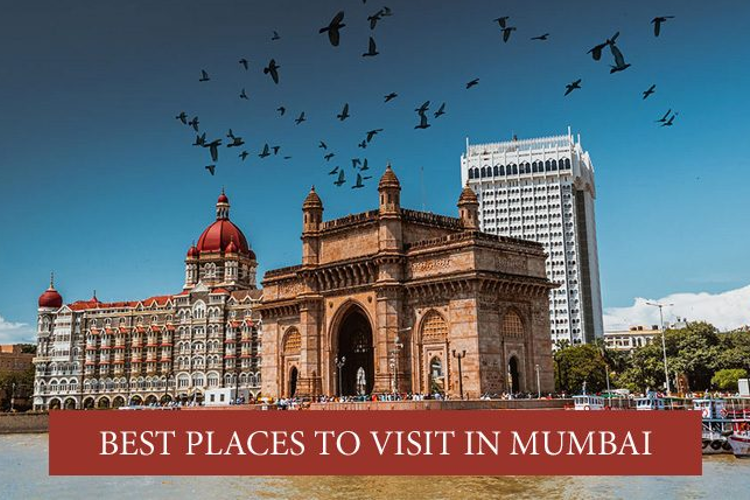
Gateway of India — the arch built for an arrival, remembered for a departure
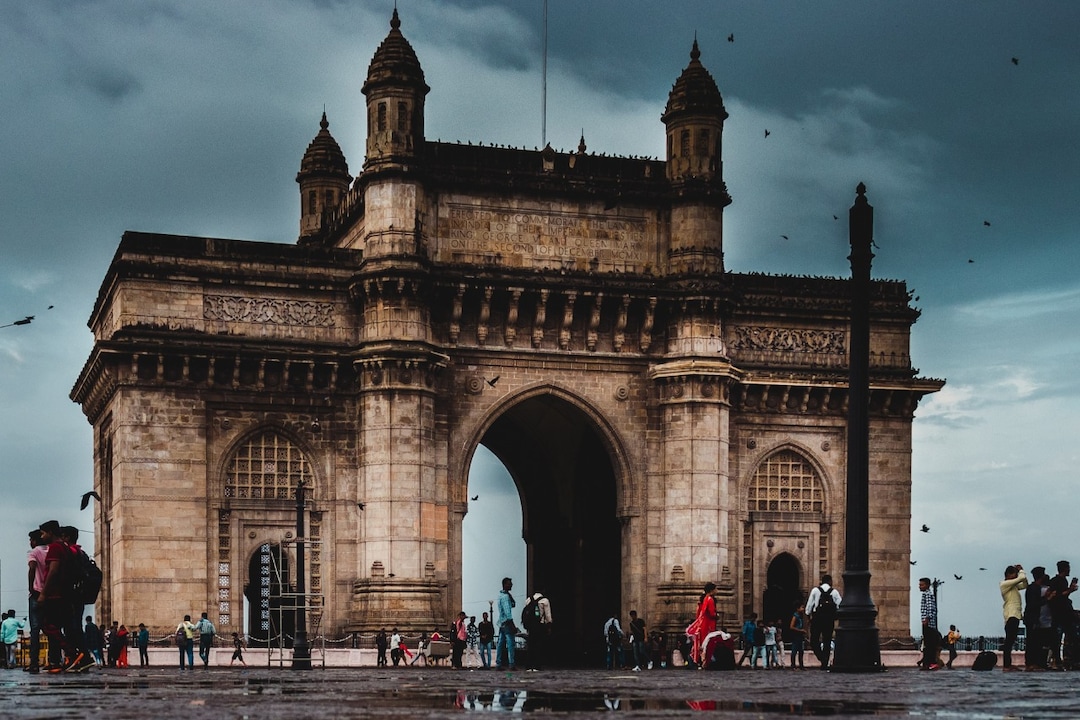
The Gateway was built to mark the 1911 landing of George V and Queen Mary — the only reigning British monarch to visit India — although the temporary structure they actually walked through was cardboard and plaster. The permanent basalt arch was not finished until 1924, thirteen years after the event it commemorates.
Twenty-four years after that, in February 1948, the last British troops in India — the First Battalion of the Somerset Light Infantry — marched through it in the opposite direction, on their way to the ships. The arch was designed as an entrance and is remembered as an exit.
Go early, before eight. By mid-morning the plaza belongs to photographers, balloon sellers and queues for the Elephanta ferry, and the thing you came to look at becomes impossible to look at.
Marine Drive — the edge the city built for itself
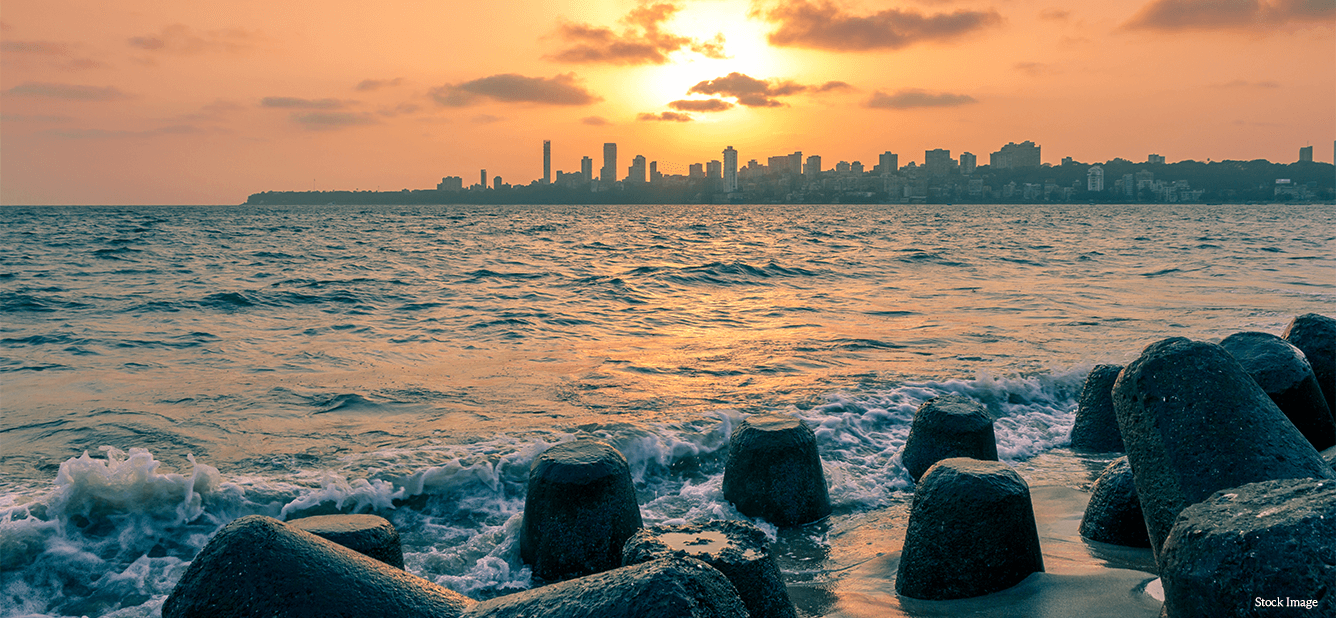
Marine Drive is a 3.6-kilometre arc of promenade along Back Bay, and it is the only item on this list that is not a door but a wall — land reclaimed from the sea in the 1920s and 30s, with a rank of Art Deco apartment blocks facing the water. Mumbai holds one of the largest surviving concentrations of Art Deco architecture in the world, second only to Miami, and the ensemble along here and around Oval Maidan is UNESCO-listed.
At night the streetlights curving along the bay produce the nickname: the Queen's Necklace. But the honest time to be there is the hour before sunset during the monsoon, when the swell comes over the tetrapods and drenches everyone on the parapet, and nobody moves. The city's relationship with the sea that made it is not affectionate exactly, but it is intimate — and the rain that arrives every June is not weather here so much as a governing fact, the same system that explains why India is not a desert at this latitude.
Elephanta Caves — the city that was here first
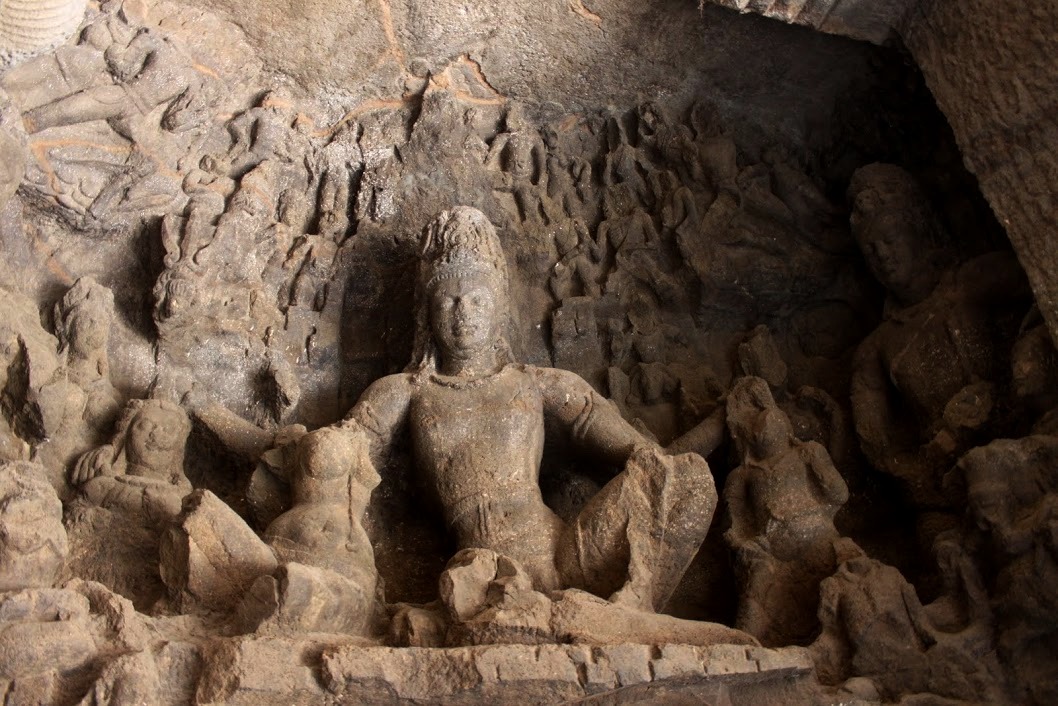
An hour by ferry from the Gateway, on the island of Gharapuri, are cave temples cut into solid basalt somewhere between the fifth and eighth centuries CE — a UNESCO World Heritage Site since 1987, and older than every other thing in this article by more than a thousand years.
The centrepiece is the Trimurti: a three-headed Shiva nearly six metres high, carved out of the living rock, showing creation, preservation and destruction in one body. Portuguese soldiers used the caves for target practice in the sixteenth century, and the damage is still there — chipped limbs, a defaced panel — which is its own kind of historical document.
Practical notes that matter more than they should: ferries run from the Gateway, roughly 9am to 2pm, and the site closes on Mondays. Allow the full day. There are about 120 steps from the jetty, and a small toy train that covers the flat part.
Chhatrapati Shivaji Maharaj Terminus — the door three million people use daily
Designed by Frederick William Stevens and completed in 1887, CSMT is Victorian Gothic Revival crossbred with Mughal and Indian decorative traditions — turrets, pointed arches, a ribbed dome executed in a way no European Gothic building would attempt, and stone carving by students of the local art school. It has been a UNESCO World Heritage Site since 2004.
What makes it unlike almost any other heritage building on earth is that it never became a museum. It is a working commuter terminus, and the people passing through it are not visiting it. They are going to work. You can stand in a UNESCO site at rush hour and be firmly in someone's way.
See it from outside at night, when it is floodlit, and from inside at around 6pm, when it is not beautiful at all and is instead the single clearest demonstration of what this city actually is.
Colaba and Haji Ali — the seams
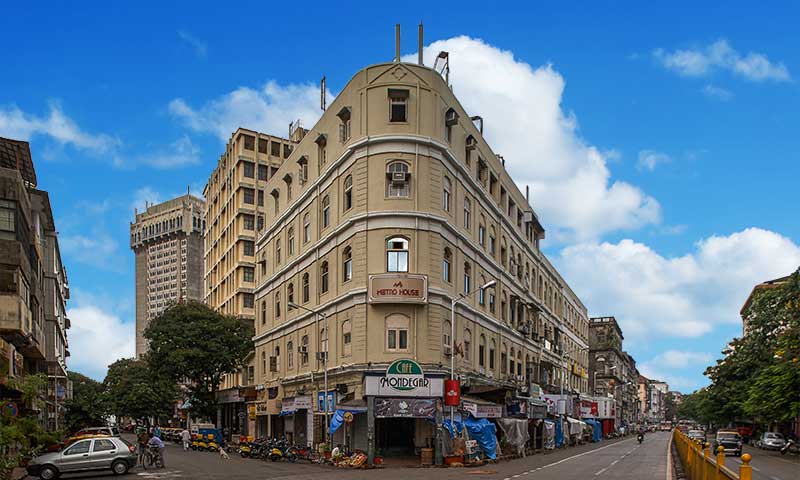
Colaba is the southern tail of the peninsula: Causeway shopping, the Regal cinema, Leopold Cafe, a fishing village that predates all of it and still lands boats, and the Taj Mahal Palace hotel, which opened in 1903 facing the harbour. It is the part of the city where the layers are stacked closest together and least tidily.
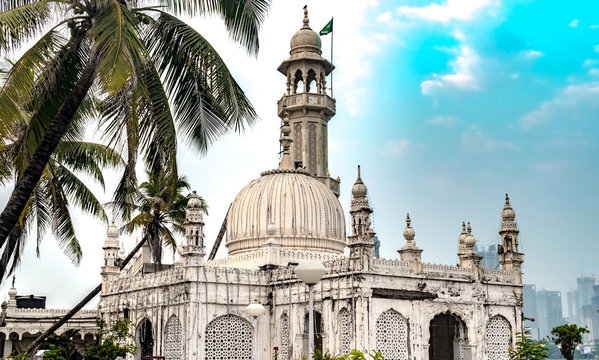
Haji Ali Dargah, north of that on Worli Bay, is the clearest physical statement of the whole threshold idea. The shrine — built in 1431, holding the tomb of the merchant-saint Sayyed Peer Haji Ali Shah Bukhari — sits on an islet, connected to the mainland by a narrow causeway with no railings that the sea covers at high tide. Twice a day the building is not reachable. Check the tide table before you go; people who do not, wait.
Sanjay Gandhi National Park — the forest inside the city
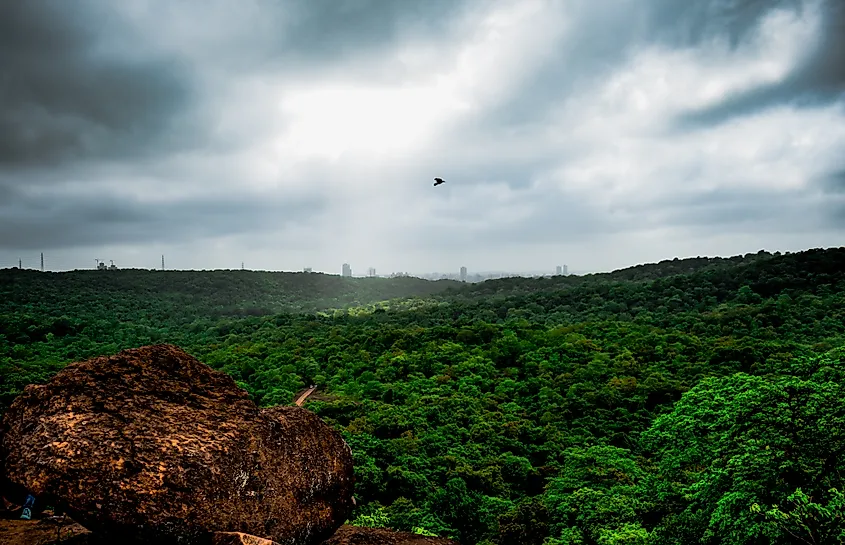
In the northern suburbs there is a national park of roughly 104 square kilometres inside the municipal boundary, and living in it is a population of leopards. The 2024 camera-trap census counted 54 in the park and adjoining areas — 36 females, 16 males — which works out to about 26 leopards per 100 square kilometres, among the highest densities recorded anywhere in the world.
They are not in an enclosure. They move through Aarey Colony and along the fringes of dense residential neighbourhoods at night, mostly hunting feral dogs, and the coexistence is managed through a genuinely unusual public-education programme rather than through removal.
Inside the same park are the Kanheri Caves — 109 rock-cut Buddhist chambers carved between roughly the first century BCE and the tenth century CE, complete with ancient rainwater cisterns. A monastery, a rainforest and a big-cat population, thirty kilometres from a stock exchange.
How to actually do this
Two days, arranged by threshold rather than by district.
Day one, south: CSMT at first light, walk to the Gateway for the early ferry, Elephanta and back by mid-afternoon, Colaba on foot, Marine Drive for sunset. Day two, north and west: Haji Ali timed to low tide, then Sanjay Gandhi National Park and Kanheri, which needs a morning to itself.
Use the suburban trains outside peak hours and taxis or the metro inside them; the peak-hour crush on the Western and Central lines is not a cultural experience, it is a crowd-density problem. November to February is dry and mild. March to May is brutally humid. June to September is the monsoon, which is the most beautiful the city ever looks and the least convenient it has ever been — worth it if you are willing to be wet for four days, and the same seasonal logic that governs travel across the subcontinent's green stretches further south.
One more site worth adding if you have a third morning: the Hanging Gardens on Malabar Hill, which have been undergoing a contested renovation programme and offer the best free view over Back Bay in the city.
Why any of this stays with you
Cities that are organised around a centre tell you a story about permanence — this is where we have always been, this is the seat of the thing. Mumbai cannot tell that story. Almost everyone in it arrived, and most of them arrived recently, and the buildings that matter are the ones marking the moment of arrival rather than the fact of settlement.
That produces a specific feeling that visitors often mistake for chaos. It is not chaos. It is a city with no origin myth available to it, run by people who are all, at some remove, still in the process of getting here. The arch faces the water. The station faces the tracks. The shrine goes underwater twice a day. Nothing here is trying to convince you it has always been.
If you want the equivalent experience at a different scale — landscape rather than architecture — India offers a whole category of it, from the places where the country keeps its stranger histories to the ranges in the north. But Mumbai is where you can watch the mechanism working in real time, at eight in the morning, on a station concourse.
Sources
- UNESCO World Heritage Centre — Chhatrapati Shivaji Maharaj Terminus
- UNESCO World Heritage Centre — Elephanta Caves
- UNESCO World Heritage Centre — Victorian Gothic and Art Deco Ensembles of Mumbai
- Sanjay Gandhi National Park — Living with Leopards
- Leopard population in Sanjay Gandhi National Park rises to 54 — 2024 camera-trap census