Why Some People Taste Words and See Sounds: The Science of Synesthesia
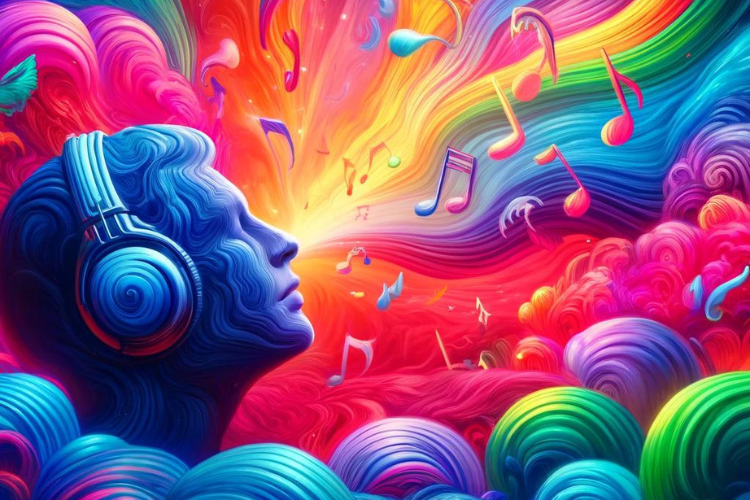
For a small slice of people, the number 7 is unmistakably green, the name Anna carries a faint taste of tuna, and a violin doesn't just sound — it glows a particular shade of amber. This isn't poetry or a trick of imagination. It's synesthesia: a real, measurable blending of the senses in which one kind of stimulus automatically triggers another. Understanding how it works changes how you think about your own perception, because the same wiring that makes it vivid in a few people is quietly present in all of us.
What synesthesia actually is
Synesthesia (from the Greek syn, "together," and aisthesis, "sensation") is a condition in which stimulating one sensory or cognitive pathway involuntarily triggers a second. A grapheme-colour synesthete doesn't decide that A is red — they simply know it as red, every time, without effort. Two features separate it from metaphor or a good memory:
- It's involuntary. The extra sensation arrives on its own and can't be switched off.
- It's consistent. For a given person, the same trigger produces the same response for a lifetime. This consistency is exactly how scientists prove someone has it, using simple test-retest tools rather than taking their word for it.
Roughly 4% of people experience some form of synesthesia — far more common than the "one-in-a-million curiosity" it was once assumed to be.
The many flavours of a blended mind
There isn't one synesthesia; there are dozens of documented forms. Here are the most studied, and roughly how common they are among synesthetes:
| Form | Trigger → Experience | Example | Notes |
|---|---|---|---|
| Grapheme-colour | Letters & numbers → colours | "7 is green; M is maroon" | The most common — about 60% of all cases |
| Chromesthesia | Sound / music → colours | A trumpet blooms orange | Common among musicians |
| Lexical-gustatory | Words → tastes | "'Jail' tastes of cold bacon" | Rare and strikingly specific |
| Spatial-sequence | Numbers / months → positions in space | The year seen as a visible loop | Often linked to strong memory |
| Mirror-touch | Seeing touch → feeling it | Feeling a stranger's stubbed toe | Tied to heightened empathy |
The trait is slightly more common in women and in left-handed people, and it very often runs in families — the first clue to why it happens.
Why it happens: a brain that never finished tidying up
The leading explanation is beautifully simple. Synesthesia appears to come from extra cross-connections between brain regions that, in most people, work separately — the "cross-activation" model. In grapheme-colour synesthesia, the brain area that recognises letters and numbers sits right next to the area that processes colour; a little extra wiring between them, and reading a 7 lights up "green" as a side effect.
Where does that extra wiring come from? Every human brain is born with far more neural connections than it will keep. Through childhood, unused connections are trimmed away in a process called synaptic pruning. The current hypothesis is that synesthetes simply prune less — they keep some of the cross-sensory connections the rest of us lose. Because this pattern is partly written in our genes, synesthesia is heritable and clusters in families.
That's the quietly profound part: synesthesia isn't a brain gone wrong. It's a brain that kept a little more of the richly interconnected wiring we all started with.
The myth worth dropping: synesthesia is not a "genius" badge
You'll see synesthesia sold online as proof you belong to some "1% genius club." That's clickbait, and it's wrong. Synesthesia is a perceptual variation, not an intelligence test — plenty of synesthetes are ordinary in every measurable way, and most highly intelligent people have no synesthesia at all. What research does suggest is a modest link to enhanced memory (those consistent colour-codes make facts stickier) and to creativity, which is why the trait shows up so often among artists and musicians. Wassily Kandinsky painted what he heard; Billie Eilish and Pharrell Williams describe building music around the colours it produces. Fascinating — but that's a creative tendency, not a smartness score.
Why it matters even if you don't have it
Synesthesia is a window into a truth about every brain: the senses were never as separate as they feel. You already blend them constantly — you "hear" a deep voice as dark, call a cheese sharp, and match high notes to bright and low notes to heavy. Newborns may experience the world as a far more merged sensory stream before pruning sorts it into tidy channels. Synesthetes simply live, all their lives, a little closer to that original, interconnected mind. Understanding them isn't learning about a rare few — it's learning how perception itself is built.
So the next time someone tells you the letter A is obviously red, don't correct them. Their brain is showing you something yours is politely hiding.