Why the World's Strangest Museums Exist — and What They Reveal About Us
A museum for broken hearts. One for toilets. One underwater. They sound like jokes — but each was built for a serious reason, and together they hold up a mirror to us.
In a quiet gallery in Zagreb, a stranger's wedding dress hangs beside a single sentence about the marriage that ended. A few thousand kilometres away in Delhi, a museum walks you through 4,500 years of the toilet. Off the coast of Cancún, an entire museum sits on the seabed, slowly turning into a coral reef. These sound like punchlines. They are not. Each was built for a serious, specific reason — and what humans choose to put in a permanent room turns out to be one of the most honest mirrors we have.
The trick to understanding "weird" museums is to stop asking "why would anyone build this?" and start asking "what human impulse is this serving?" Do that, and the strangeness dissolves into something clearer. Almost every unusual museum on earth is built around one of five deeply ordinary human needs.
The five reasons strange museums exist
| The impulse | What it means | A real museum built on it |
|---|---|---|
| To rescue the overlooked | Give importance to something everyone ignores | Sulabh International Museum of Toilets (Delhi) |
| To teach the hard-to-see | Make the invisible or taboo learnable | Mütter Museum (Philadelphia); Icelandic Phallological Museum (Reykjavík) |
| To grieve what has no ritual | Create a place for feelings society won't formalise | Museum of Broken Relationships (Zagreb) |
| To protect something fragile | Use attention to save what attention destroys | MUSA underwater museum (Cancún) |
| To honour everyday genius | Celebrate a small invention that changed millions of lives | Cup Noodles Museum (Yokohama) |
To rescue the overlooked
The Sulabh Museum of Toilets in Delhi traces sanitation across 4,500 years — ancient chamber pots, medieval commodes, futuristic designs. It's easy to smirk, until you see the point: it exists as part of a mission to make sanitation visible in a country and a world where poor sanitation still kills. Making a museum out of the toilet is a way of insisting that the unglamorous thing everyone depends on, and no one discusses, actually matters. That's not weird. That's brave.
To teach the hard-to-see
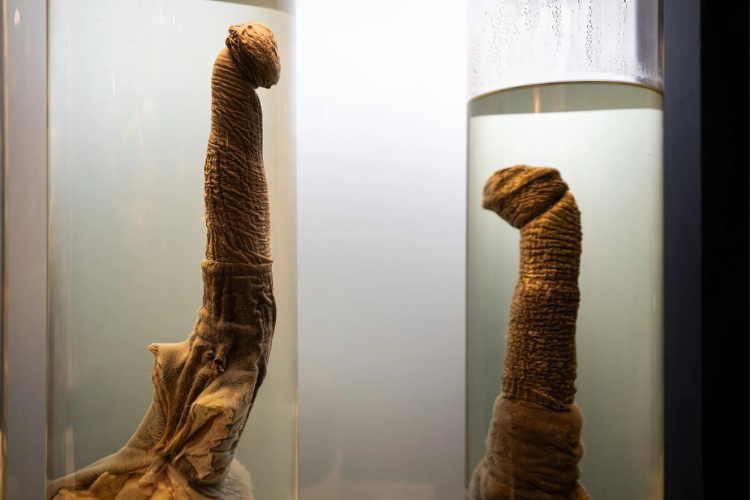
Philadelphia's Mütter Museum holds tens of thousands of anatomical specimens — the medically strange and the pathological. It began not as a freak show but as one surgeon's teaching collection: Dr. Thomas Mütter believed doctors learn by seeing, and willed his specimens to be permanently displayed for medical education. Reykjavík's Icelandic Phallological Museum — the world's largest collection of mammalian phalli — sounds like pure shock value, yet visitors routinely leave surprised by how genuinely zoological it is, each specimen labelled with real biology. Both museums do the same quiet thing: they make us look, calmly and scientifically, at things we're taught to look away from.
To grieve what has no ritual
The Museum of Broken Relationships in Zagreb grew from a simple observation by its founders: society hands us rituals for weddings, funerals, and graduations, but nothing for the end of a relationship. So they built one. Every object — a toaster, a wedding dress, an axe — comes with a short, anonymous story of the love that ended. Ordinary things become almost unbearably powerful once you know what they meant to someone. It is, in effect, a public funeral for private heartbreak — a feeling billions share and no calendar marks.
To protect something fragile
Off Cancún, the Museo Subacuático de Arte (MUSA) placed hundreds of sculptures on the seabed. It's art, but its real job is conservation: Cancún's natural coral reefs were being loved to death by millions of divers and snorkelers. The submerged statues were designed to pull that traffic away from the living reef — and, built from pH-neutral marine concrete, to slowly become artificial reef themselves. It's a museum that exists to save the thing outside it.
To honour everyday genius
Yokohama's Cup Noodles Museum celebrates a single humble invention — instant ramen, created by Momofuku Ando to feed people cheaply after World War II. You can even blend your own cup. It sounds trivial until you remember that this one idea has fed billions of people in dorm rooms, disaster zones, and lonely late nights. The museum is a reminder that world-changing genius often looks, at first, like a small convenience.
What they actually reveal
Here's the turn. A country's grand national museum tells you what a society wants to be seen valuing — its kings, its wars, its masterpieces. Its strange little museums tell you what it actually can't stop thinking about: death and the body, love and its loss, sanitation, the sea, a cheap warm meal. The unusual museum is often the more honest one, because no one builds a museum out of obligation to a toilet or a heartbreak. They build it out of genuine, unignorable care.
And in an age when we photograph everything and remember almost nothing, the deepest thing these places do is choose. To build a museum is to declare that a specific slice of human experience deserves a permanent room and a careful label — that it should outlive the people who lived it. The world's strangest museums aren't jokes about what's weird. They're arguments about what's worth remembering. And that argument tells you more about us than any hall of kings.
Sources
- Museum of Broken Relationships — official
- MUSA Underwater Museum — official
- Mütter Museum — Visit Philadelphia
- Museum of Broken Relationships — Wikipedia
Keep exploring: the science of synesthesia · why touching space is almost cheap · India's "mystical" places, explained.