Why Will the Moon Turn Red Tomorrow? The Science Behind August’s Rare Lunar Eclipse
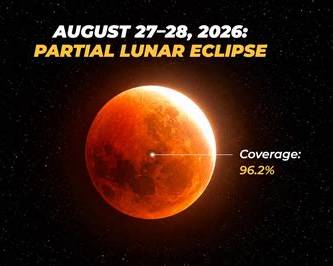
Tomorrow morning, the Moon will briefly slip into Earth’s shadow, creating a celestial event that may make part of its surface appear reddish-orange.
The August 28, 2026 partial lunar eclipse will be visible from parts of India, although skywatchers will have only a short window to catch the most dramatic phase. In India, the partial eclipse begins at 5:33 AM, reaches its locally visible maximum at 6:16 AM, and the Moon sets at about 6:19 AM.
But why does the Moon turn red during an eclipse?
Earth’s Shadow Is Only Half the Story
A lunar eclipse happens when Earth moves between the Sun and the Moon, causing Earth's shadow to fall across the lunar surface.
During a partial lunar eclipse, only part of the Moon enters Earth's darkest shadow, known as the umbra. The rest remains illuminated by sunlight.
That's what will happen tomorrow. The alignment will not be perfect enough to cover the entire Moon.
The interesting part is what happens to the sunlight that still manages to reach the Moon.
Why Does the Moon Look Red?
Earth's atmosphere acts like a giant filter.
When sunlight passes through the atmosphere, shorter blue wavelengths scatter more easily, while longer red and orange wavelengths travel through more effectively. Some of that filtered reddish light is bent toward the Moon.
That is why an eclipsed Moon can take on a copper, orange or reddish appearance.
NASA compares the effect to having the world's sunrises and sunsets projected onto the lunar surface.
The exact shade can also depend on conditions in Earth's atmosphere. Dust, clouds and other particles can influence how much red light reaches the Moon.
Why Is This Eclipse Difficult to See From India?
India gets an unusual view of this eclipse.
The partial phase begins when the Moon is already quite low in the western-southwestern sky. At 5:33 AM, the Moon will be only about 6 degrees above the horizon. By the locally visible maximum at 6:16 AM, it will be just 0.2 degrees above the horizon, before setting around 6:19 AM.
That means buildings, trees and haze could easily block the view.
For anyone hoping to see it, an unobstructed western-southwestern horizon and a high vantage point will make a big difference.
Why Don't We Get Eclipses Every Month?
The Moon goes around Earth roughly once a month, so it might seem strange that lunar eclipses aren't monthly events.
The reason is that the Moon's orbit is tilted relative to Earth's orbit around the Sun. Most full Moons therefore pass above or below Earth's shadow.
Only when the Sun, Earth and Moon line up closely enough does an eclipse occur.
Tomorrow's event is therefore more than just a red Moon.
It is a reminder that something as familiar as the Moon can become dramatically different when the geometry of three worlds lines up at exactly the right moment.