Why Astronauts Grow Vegetables in Space — and Why Mars Depends on It
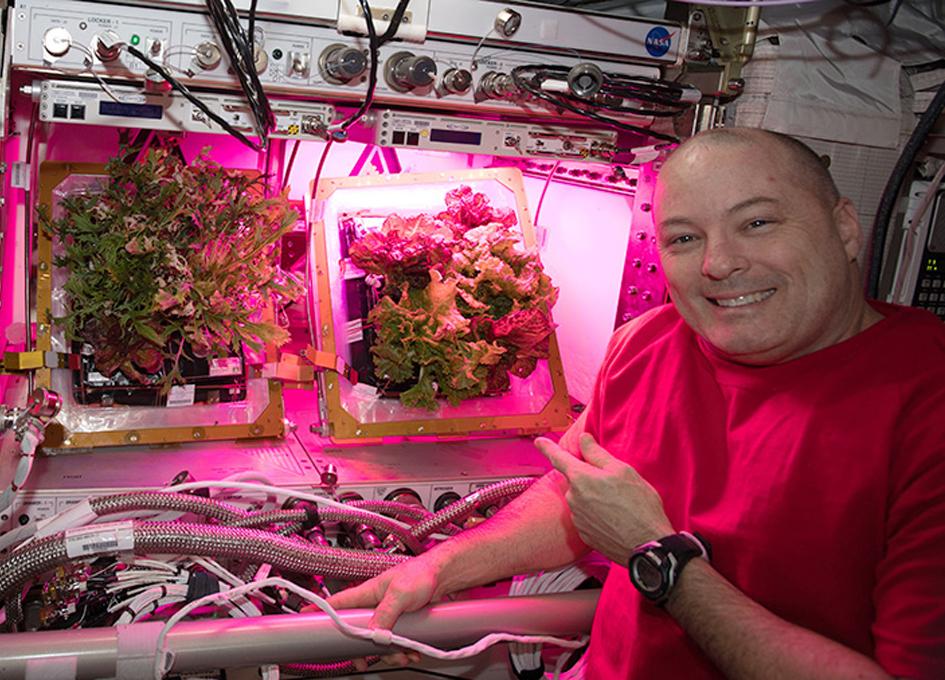
In a video posted in mid-August 2026, two astronauts float in front of a small illuminated box on the International Space Station and cut leaves off a plant. They season them. They eat them. One of them says it might be the best meal they have cooked up there.
The plants were Red Russian kale and wasabi mustard, grown for about a month inside NASA's Veggie chamber. Jessica Meir had introduced them to the internet a couple of weeks earlier as the newest members of Expedition 75. Anil Menon posted the harvest and thanked the Veggie team on the ground for talking them through it.
It looks like a hobby. A grow-light, a few leaves, some very expensive salad. And the reflex is to file it under morale — nice for the crew, not really science.
That reflex is wrong, and the reason it is wrong has almost nothing to do with salad.
What is actually growing up there
There are two plant systems on the station, and they do different jobs.
Veggie — formally the Vegetable Production System — has been running since 2014. It is deliberately low-tech: a collapsible bellows, a bank of red, blue and green LEDs, and a set of "pillows," small fabric bags of baked clay substrate and slow-release fertiliser with wicks poking out. Crew water them by hand with a syringe. Veggie is the kitchen garden, and it is designed to be simple enough that a human being with other jobs can keep it alive.
The Advanced Plant Habitat, installed in 2018, is the laboratory. It is sealed, automated, and instrumented — controlling light spectrum, humidity, carbon dioxide, and water delivery, with more than 180 sensors reporting to the ground. Crew involvement is minimal by design, because the point is to isolate variables rather than to feed anyone.
The crop list across both systems now runs to more than a dozen species. Outredgeous red romaine lettuce was the first food grown in orbit and eaten by a crew, in August 2015. Zinnias flowered in 2016 — the first flowering plant taken through a full cycle in space, and the run that taught the programme most of what it knows about mould. Mizuna mustard greens followed. Chile peppers in 2021 produced the largest harvest yet attempted, partly because capsaicin heat is one of the few flavours that still registers properly in a congested, fluid-shifted head. Now kale and wasabi mustard.
Roughly a decade of work, and the total mass of food produced would not fill a supermarket trolley. The output being measured is not the food.
The Resupply Horizon
Here is the framework that makes the whole programme legible. Call it the Resupply Horizon.
The Resupply Horizon is the distance at which sending things from Earth stops being a budget problem and becomes a physics problem. Inside it, a shortfall is an inconvenience — order another cargo flight. Outside it, a shortfall is permanent, because there is no trajectory that gets a package to you before you need it.
The International Space Station sits deep inside the horizon. It is 400 kilometres up, resupplied several times a year, and reachable within about a day. Nothing aboard it has to be self-sufficient, which is precisely why nothing aboard it has ever properly tested self-sufficiency.
Mars sits far outside. Launch windows to Mars open roughly every 26 months, and a round trip is measured in years. A crew that discovers a problem with its food supply eighteen months out has no options that involve Earth. The same is increasingly true of a sustained base at the Moon's south pole, which is closer but still expensive enough per kilogram that shipping every calorie is a losing proposition.
Everything strange about deep-space engineering follows from where that line falls. Water recycling, oxygen regeneration, 3D-printed spares, and yes, plants — none of these are efficiency measures. They are what you build when a supply chain physically cannot reach you. Growing kale on the ISS is not a rehearsal for growing kale. It is a rehearsal for crossing the horizon.
The vitamin problem nobody expected
The most concrete argument for space agriculture is one that took decades to notice, because it only appears on long timescales.
Spaceflight food is engineered for shelf stability. It is thermostabilised, irradiated, freeze-dried, and packaged to survive years without refrigeration, and by the standards of calories, protein, fat and minerals, it does that job well. The problem is the vitamins.
Several essential micronutrients — vitamin C, vitamin K, thiamine, folate — degrade steadily in storage regardless of how well the packaging performs. Over the six-month rotations typical of station crews, the loss is manageable and can be topped up with supplements. Over a Mars-class mission, where food may be prepositioned years before the crew arrives and consumed years after that, the nutritional content of the pantry can drift meaningfully below what was loaded.
Supplements are not a clean fix. Isolated compounds in a pill do not behave identically to the same compounds in a food matrix, absorption varies, and pills have their own shelf-life curve. A leaf, by contrast, manufactures its vitamins on demand and delivers them a few minutes old. Leafy greens are unusually good at exactly the nutrients that fail first: kale and mustard greens are dense in vitamins K, C and A.
This is why the crop list looks the way it does. Nobody is trying to grow wheat in orbit. The target is the specific, narrow set of nutrients that a shelf-stable pantry cannot hold — the gap between what you can pack and what a body needs.
How you water a plant that does not know which way is up
Growing anything in microgravity means discovering how much of terrestrial botany was quietly outsourced to gravity.
Roots on Earth grow down because of gravitropism — specialised cells containing dense starch grains that settle and tell the root which way is down. In orbit, nothing settles. Those cells give no signal at all. What the programme found is that plants fall back on other cues: roots follow moisture gradients, shoots follow light. Orientation still happens; it is just driven by hydrotropism and phototropism instead. That is a genuinely interesting result about plant biology that could not have been obtained on the ground.
Water is harder. Without gravity, water does not drain, spread or pool — surface tension dominates, and a droplet will happily wrap itself around a root and refuse to leave. Over-water a space plant and you drown it in a film it cannot shed; under-water it and the substrate dries unevenly. Hence the clay pillows and wicks, which use capillary action to move water at a rate the plant can actually use.
Then there is air. On Earth, warm air rises off a leaf and cool air replaces it — convection, driven by gravity. In orbit there is no convection. A leaf sitting in still air rapidly exhausts the carbon dioxide immediately around it and sits inside a stagnant bubble of its own transpired water vapour and exhaled oxygen. It effectively suffocates in place. Every plant chamber flown to date has needed forced airflow for this reason alone, which is also why the systems are noisier than they look.
And ethylene, the plant hormone that triggers ripening and ageing, accumulates in a sealed cabin instead of dispersing, accelerating senescence across every plant at once. The station's air scrubbers have to handle it.
Microbes love a salad
The complication that gets least attention is biological, and it connects to a much bigger conversation in spaceflight.
A plant chamber is warm, humid and rich in nutrients, inside a spacecraft that is otherwise dry and engineered to be inhospitable. It is, from a microbe's perspective, the best address in the vehicle. The zinnia run in 2016 nearly failed because of mould, and the recovery — adjusting airflow and watering, with the crew making judgement calls rather than following a script — is still one of the more instructive episodes in the programme.
So the produce is surface-sanitised before it is eaten, samples are returned to Earth for microbial characterisation, and the community around each crop gets catalogued. That work overlaps directly with the growing concern about the microbes humans carry to other worlds. A crew that grows its own food is running a small, deliberate ecosystem inside a sealed vehicle, and the same organisms that thrive in a plant pillow are the ones most likely to make it to a lunar or Martian surface intact.
Closing a life-support loop and controlling contamination are, in the end, the same engineering problem approached from opposite ends.
Why cutting a leaf changes the mood on a space station
Now the part that gets dismissed as soft, and should not be.
A spacecraft is an environment of total sensory constancy. Every surface was designed. Every sound is machinery. The temperature does not vary, there is no weather, no seasons, no dirt, and nothing decays or grows or surprises anyone. It is the most controlled environment humans have ever inhabited, and control is exactly what makes it psychologically expensive. There is no novelty that the crew did not bring with them.
A plant is the only thing aboard that does something nobody scheduled. It grows overnight. It leans toward a light. It is measurably different on Thursday than it was on Monday. Behavioural health researchers have tracked this across analogue missions in Antarctica and submarines as well as in orbit, and the effect is consistent enough that crop selection now formally weighs it — the reason zinnias and chile peppers were flown was never nutritional.
Watch the video of the kale harvest with that in mind and the reaction reads differently. It is not enthusiasm about vegetables. It is what happens when people who have spent months inside a machine get to eat something that was alive ten seconds ago. That response is data too, and it will matter more on a three-year Mars transit than any vitamin.
It also hints at what the coming decades of human spaceflight will actually feel like. As access widens — from national astronaut corps toward commercial crews and paying passengers — the design problem shifts from survival to habitability, and habitability turns out to be substantially about having something living nearby.
What happens next
Three things to watch.
The first is a shift from leaves to calories. Every crop grown so far is a garnish; none of it displaces meaningful mass from the pantry. The real threshold is a staple crop — dwarf wheat, potatoes, soy — grown to full harvest in a controlled chamber, because that is the point where a food system stops supplementing and starts substituting. Expect that to be attempted on the ground in high-fidelity analogues long before it flies.
The second is surface agriculture. Growing in a pressurised module on the lunar surface introduces variables the station cannot test: one-sixth gravity rather than none, a two-week night to power through, and the eventual question of whether regolith can be processed into something a root will tolerate. Lunar greenhouse concepts are already queued behind the first crewed Artemis landings.
The third is loop closure. Plants do not only produce food — they consume carbon dioxide, release oxygen, and transpire water that can be condensed and reclaimed. Current systems are far too small to contribute measurably to life support. The question that decides whether crewed Mars missions carry gardens or pantries is whether a plant system can be scaled to pay for its own mass, power and crew time. Nobody has demonstrated that yet.
Which is the honest summary of the kale. It was not a milestone. It was one more data point in a slow argument about whether humans can carry a functioning piece of Earth past the point where Earth can reach them — and so far the argument is going better than anyone expected in 2014, and not nearly well enough to bet a Mars crew on.
Sources
- NASA — Growing Plants in Space: Veggie and the Advanced Plant Habitat
- NASA — Astronauts harvesting mustard greens aboard the space station
- Reader's Digest — Astronauts grew farm-to-table kale in space, and why it matters
- NASA — Nutrition research aboard the International Space Station
- NASA — Space food systems and crew nutrition