Why Scientists Are Worried About Earth’s Microbes Reaching the Moon
There is a patch of skin on your arm about the size of a pencil eraser. It has roughly a million bacteria living on it. You cannot feel them, you have never met them, and they will go wherever you go for the rest of your life.
That is the uncomfortable premise behind a NASA-led study published in Science Advances on 19 August 2026. Led by planetary scientist Prabal Saxena at NASA's Goddard Space Flight Center, the team modelled what would happen to five kinds of human-associated microbes if they were carried to the Moon's south polar region — the exact stretch of terrain that Artemis missions, Chinese landers, and a queue of commercial spacecraft are all now aiming for.
The answer was not what the Moon's reputation would suggest. Some of them would still be alive the next day.
What the study actually found — and what it did not
The finding needs handling carefully, because the headline version is louder than the science.
The researchers were not claiming that the Moon can host life. They were not claiming microbes could grow, reproduce, or establish anything resembling an ecosystem. The word doing the work in the paper is viable, and the threshold used is deliberately modest: could a given microbe remain alive for at least one Earth day in a shaded lunar niche?
For several of the organisms tested, the modelled answer was yes. The most durable performer was Aspergillus niger, a common mould with unusually tough, UV-resistant spores, which the models suggested could tolerate even some sunlit exposure. Others survived only in shadow, and only briefly.
One day is not immortality. But one day is enormously longer than "instantly sterilised," which is what most people assume the lunar surface does to anything organic. And a day is more than enough time to be scooped up in a sample, sealed in a container, and carried into a laboratory where someone is trying to work out whether the molecules they are looking at came from the Moon or from the person who collected them.
The Moon has hidden shelters
The surprise in the paper is not really about the microbes. It is about the terrain.
The lunar surface is genuinely hostile: no atmosphere, unfiltered solar ultraviolet, cosmic radiation, and temperature swings of hundreds of degrees between lunar day and lunar night. Almost nothing survives that.
But the Moon's south pole is built differently. Its rotation axis is tilted barely at all relative to the Sun, which means that near the poles, sunlight arrives at a permanent grazing angle. Crater rims cast shadows that never move. Inside some of those craters are floors that have not seen direct sunlight for perhaps two billion years — permanently shadowed regions, or PSRs, where temperatures fall to around minus 230 degrees Celsius.
Those are the coldest places measured anywhere in the solar system, colder than the surface of Pluto. And cold that extreme behaves like a trap: any volatile molecule that wanders in — water, methane, ammonia, organic compounds — sticks and stays. Which is precisely why everyone is racing to the Moon's south pole in the first place. The ice in those craters is fuel, drinking water, breathable oxygen, and a frozen archive of what has been drifting through the inner solar system for aeons.
The same shadow that preserves that archive also blocks the ultraviolet light that would otherwise kill a bacterium in minutes. The Moon's best scientific real estate and its best microbial hiding place turn out to be the same square kilometres.
The Palimpsest Problem
Here is the framework that makes this worth caring about. Call it the Palimpsest Problem.
A palimpsest is a manuscript that was scraped clean and written over, so that two texts occupy the same page and each one damages the reading of the other. Medieval scribes made them because parchment was expensive. Scholars now spend careers trying to recover the erased layer underneath.
Every place humans reach is at risk of becoming a palimpsest. We arrive to read something — a geological record, a chemical history, a question about whether life started more than once — and the act of arriving begins writing our own text over it. The reading and the overwriting happen at the same time, by the same people, using the same vehicle.
What makes the Palimpsest Problem sharp rather than merely poetic is that it is asymmetric in time. The original text took two billion years to accumulate and cannot be restored. The overwriting takes one landing. There is no version of this where we contaminate the south pole, learn our lesson, and reset the experiment.
So the relevant question is never "will microbes take over the Moon?" It is: how much of the record can we read before our own signal becomes indistinguishable from the ancient one? That window is open now. It closes with traffic, not with time.
How a microbe gets to the Moon in the first place
Spacecraft are not sterile. They are clean, which is a different and much weaker claim.
Hardware destined for space is assembled in cleanrooms with filtered air, gowned technicians, and rigorous procedures, and the resulting bioburden is measured and logged. But cleanrooms select rather than eliminate. The organisms that persist in them are, by definition, the ones that tolerate desiccation, disinfectant, low nutrients, and radiation — exactly the traits that later make a microbe a good candidate for surviving a lunar shadow. Decades of cleanroom microbiology have produced a strange catalogue of hardy specialists that thrive in the places we built to be uninhabitable.
Crewed missions change the maths entirely. A robotic lander carries whatever survived assembly. A crew carries four human microbiomes — trillions of organisms in the gut, on the skin, in the airway — plus everything living in the food, the fabric, the water system, and the air filters. Life-support systems that recycle water and air are, functionally, incubators with a mission patch. This is why microbial monitoring is a standing task on the International Space Station, and why the same concern quietly shapes experiments like growing fresh vegetables in orbit: a plant chamber is a warm, humid, nutrient-rich box in an otherwise dry spacecraft, and it has to be managed accordingly.
There is also a cautionary tale here that is usually told wrong. When Apollo 12 astronauts retrieved a camera from the Surveyor 3 probe in 1969, analysts reported finding live Streptococcus mitis that had apparently survived nearly three years on the Moon. It became one of spaceflight's favourite stories. It has since been picked apart fairly convincingly: the handling procedures in the receiving lab were loose enough that the bacterium was most likely introduced after the camera came home. The story survives as a lesson about a different kind of contamination — the kind that happens to your data rather than to your destination.
What is actually at risk is the science
It is worth being precise about the stakes, because the alarming framing and the real one point in different directions.
Earth microbes are not going to colonise the Moon. There is no liquid water at the surface, no atmosphere, no energy gradient, and no nutrient cycle. A dormant spore in a cold trap is not an ecosystem. The Moon is in no danger from us in any biological sense.
The danger runs the other way. The PSRs are being approached as a scientific instrument — a two-billion-year cold-storage record of the volatiles and organic chemistry delivered to the inner solar system by comets and asteroids. That record is only useful if you can trust it. Introduce terrestrial organics and terrestrial biology into the same craters, and every future measurement acquires an asterisk. Was that amino acid ancient, or did it arrive on a glove? Is that isotope ratio a clue about the early solar system, or an artefact of a lander's exhaust plume?
Ambiguity of that kind is not recoverable by better instruments. Once the provenance question exists, it exists permanently.
Why this is not treated like Mars
Under the international planetary protection framework that grew out of the Outer Space Treaty, destinations are ranked by how much we care about contaminating them. Mars, with its subsurface ice and its live debate about past or present life, sits at the strict end: hardware is baked, sterilised, and budgeted against microbial counts, and certain regions are effectively off-limits to anything that has not been cleaned to an extreme standard.
The Moon has historically sat near the permissive end — a destination of limited biological interest, requiring documentation rather than sterilisation. That classification was written when the Moon was understood as a dry, dead rock and when nobody was planning to live there.
Both of those assumptions have expired. The confirmation of water ice in the polar cold traps turned the Moon into a site of real astrobiological interest, and the current programmes are aiming at sustained presence rather than brief visits. A 2026 modelling paper showing that human-associated microbes stay viable in exactly those craters is, in policy terms, a request to reopen the file. That is the actual significance of the Saxena study: not a warning about lunar infection, but an argument that the Moon's protection category was set using outdated facts.
What this says about us
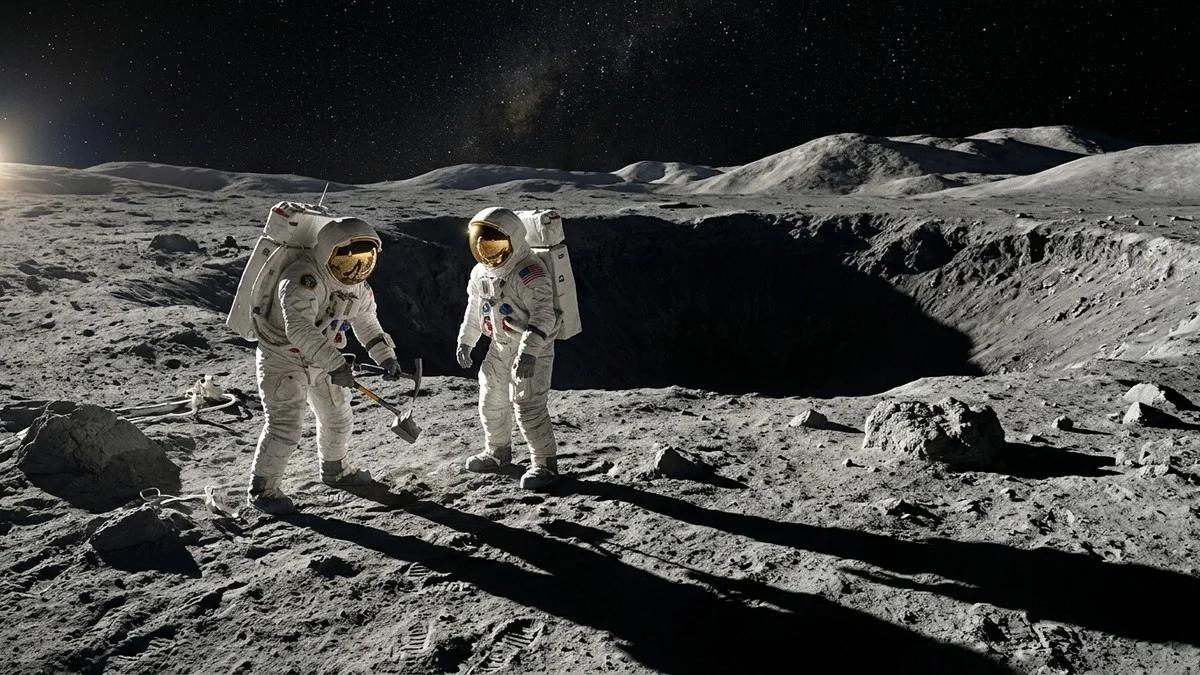
There is something clarifying about the image at the centre of this. Humanity's great return to the Moon — the flags, the landers, the geopolitics, the language of frontier and destiny — and the thing that actually gets there first, reliably, without any planning at all, is a mould spore in the lining of a spacesuit.
We tend to imagine exploration as an act of one-directional observation: we go, we look, we come back knowing more. It has never worked that way. We are not observers; we are ecosystems in a pressure suit. Wherever we go, we bring a biological entourage that has been travelling with our species for its entire existence and that has already reshaped every environment we have ever entered on Earth.
The Moon simply makes the pattern legible, because it is the first place where the entourage cannot spread, cannot compete, and cannot hide — it can only smudge the page. That is a smaller consequence than an invasion, and in some ways a more sobering one. It means the limiting factor on what we learn out there may turn out to be our own hygiene.
It is the same instinct visible in every stage of the current expansion off-world, from the arrival of paying space tourists to the growing commercial lander traffic: the capability arrives first, and the question of what it costs the record arrives afterwards, usually from people with much smaller budgets.
What happens next
Three things are worth watching.
The first is laboratory confirmation. The Saxena results are modelled, using simulated lunar conditions rather than lunar ones. The obvious follow-up is hardware — sealed microbial payloads flown to the polar region and recovered, or at least monitored in situ. Until that exists, the survival estimates remain a well-argued prediction.
The second is policy. Watch for movement inside COSPAR's planetary protection panel on whether the polar cold traps should be carved out and treated as a restricted zone, with tighter bioburden limits than the rest of the lunar surface. That is a cheap, targeted fix if it happens before the traffic arrives, and an expensive, unenforceable one afterwards.
The third is baselining, and it is the most urgent. Every mission that reaches the south pole from here on should be characterising its own microbial cargo before launch, so that anything found later can be checked against a known list. A contamination record is not as good as a clean site. But it is the difference between an ambiguous measurement and a correctable one — between a page you cannot read and a page with a legible margin note explaining what was written over it.
The ice in those craters has been waiting two billion years. Deciding how carefully to approach it is a question with, realistically, a few years left on it.
Sources
- NASA Science — Human-Related Microbes May Survive Moon's South Pole, NASA Finds
- Phys.org — Human-related microbes may survive moon's South Pole
- ScienceDaily — NASA finds Earth microbes could survive on the Moon
- NASA Office of Planetary Protection — mission categories and requirements
- NASA — Artemis III mission overview and south polar landing region